



Deep Fried Turkey (Still the best guide on the net!)

 4.20 average, 193 votes
 Loading...
 Print This
Last updated November, 2023.
Prep time:
Cook time:
Carryover and carving time: 45 mins on average
Total time:
First timer total time: 4 hours
INTRODUCTION TO DEEP FRIED TURKEY
How many times have you sliced into a tasteless, bone-dry turkey on Thanksgiving wishing your fowl had not run afoul in the oven? This year, try frying your bird instead.
Why fry? There is no other way I can think of to cook that will give you a moist, delicious turkey in such a short period of time. The skin will be crispy and the meat will be juicy and–depending on how you marinade it–spicy.
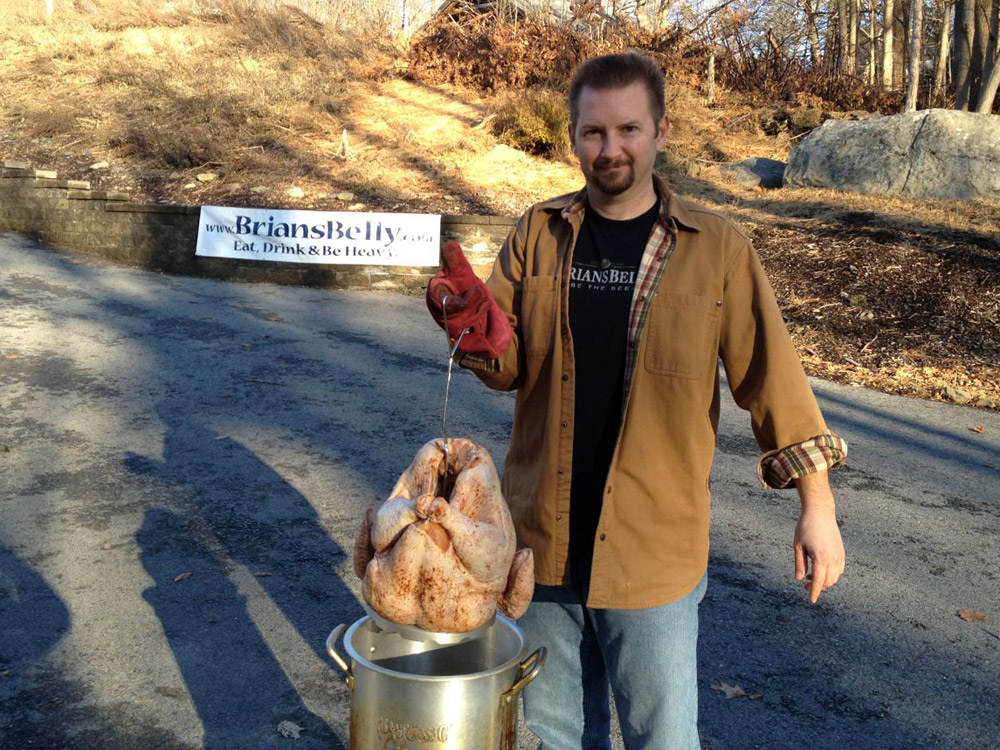
Deep frying a turkey is not a horribly difficult thing to do, but it requires some preparation and effort to do it right, especially the first time.
There are plenty of variations from this recipe that can be done, and if you know what you’re doing then by all means go ahead and variate. But if you’ve never done this before then pay attention, I’d hate to hear that you had deep fried arm for dinner.
A word of caution right from the start- this whole process must be done outside. Keep in mind that you will be working with bubbling, spitting oil heated to 350° Fahrenheit. There are plenty of stories that circulate on the web about people who have burned their house down attempting to do this inside.
Don’t just take our word for it:
Consumer Reports has issued a caution on turkey fryers stating that Underwriters Laboratories (UL) has refused to certify any turkey fryer as safe! UL said all of six cookers examined could overheat oil to the point of combustion and goes on to use words like “scalding,” “flames.” “engulfed” and “fire.” Don’t say we didn’t warn you to do this outside. For more info, check out Consumer Reports. If you insist on doing this in your kitchen, CU has reviewed a small electric fryer, which may not burn your house down as often. This fryer is also available at Amazon.
BEGINNERS
Aside from the regular ingredient list, first time fryer’s are going to need the right utensils. Only a few years ago, I would have told you to start with a big pot and a wire hangar and scrounge up the rest of what you’ll be needing. But today there are quite a few companies that make all-in-one kits. A basic kit includes a large pot, turkey stand, lift hook & fry thermometer. Spend a little more and get one that includes an injector and a burner if you don’t already own one. The addition of a smaller fry pot and a basket will turn that one-hit kit into a frying multi-tasker. Make sure the pot is at least a 26qt… you can get a 30qt. or more, but consider this: you’ll have more room to breathe, but if you’re going to only be cooking 10 pound birds, that larger pot will just waste oil.
Eastman Outdoors has a prominent history building and supplying outdoor cooking appliances, and many of them are readily available online. Eastman makes many kits with aluminum and stainless steel pots. If you are one of those people that likes shiny new toys, go for the stainless steel 30-quart professional kit
If stainless is a little too costly, try one of Eastman’s aluminum combos
Then there is Bayou Classic, another brand we highly recommend, who makes several size kits- a 28qt., a 30qt. and a 34qt. aluminum pot kit- the burner can be cranked up to 185,000 BTU’s. It has a 14″ wide welded steel frame (that is quite rugged) and a turkey stand & hook. The only thing we don’t like about this kit is the plastic injector. The Bayou Classic brand is sold online (extensively) and nationally at Home Depot, and can be found for as low as $136, or as much as $200 for a full-out stainless kit.
Chef William’s (of QVC fame) may or may not still sell kits, but it’s just as well. The original fryer we had for review was poorly made and used a basket to fry the turkey instead of a stand. But his Cajun Injector is still available, and is still the best injector you can buy.
Other brands we don’t know too much about are King Kooker which we’ve seen at Dick’s Sporting Goods & Sam’s Club and Kamp Kitchen which we’ve seen online. As with anything, you get what you pay for, so be wary of low, low prices.
Overall, our recommendation would be the Eastman or Bayou Classic brands for a kit and then a marinade pack that comes with an injector.
As we mentioned in eye-catching blockquotes above, at this time NO turkey fry kits are UL listed, so cook with caution. There are a few so-called “safer” alternatives that have come on the market in the past few years such as the very highly review-rated Char-Broil Big Easy Oil-Less Infrared Turkey Fryer and the Masterbuilt Indoor Electric Turkey Fryer
It seems each comes with it’s own tradeoffs for each advantage: The infrared model may be safe because it uses no oil, but hey… it uses no oil, so that’s not much of a fryer… and it takes 10 minutes per pound to cook. The electric Masterbuilt has eliminated our main complaint and no longer has a 14lb limit… a newer X-tra freakin’ large version can handle birds up to 20lbs and can be used indoors with less oil. It also has a thermostat. The real tradeoff comes with the lack of the outdoor bonding experience with the beer-drinking men if you choose to use it inside… you may end up in the kitchen with the ladies, and you can’t wear a Real Men Fry Turkeys fry guard and Gauntlet Gloves in there… it’s an apron and oven mitts for you.
GETTING STARTED
Before creating an actual ingredient list, let me tell you a bit about why you’re going to need the things on the list.
A 15-19 pound turkey is about the maximum size to deep fry. Aside from being unwieldy, larger birds need to cook much longer. Your Birdzilla would take over an hour and most likely the skin and tasty appendages would be overcooked. That said, you can cook larger birds (up to 20 pounds, or whatever fits in your pot) but make sure the wings are in the overhead position (see below) and the legs are tied to the holder so that they don’t splay open.
An injector is used to infuse the bird with liquid seasoning. When the oil sears the skin of the turkey on contact, the natural juices and the marinade are sealed in- meanwhile, the oil is sealed out. I’ll explain how to do this later on when we inject the bird. The dry seasoning is used as a dry rub on the skin of the turkey (and inside if you’d like). I love Tony Chachere’s Original Creole Seasoning
 The oil you use is up to you but most prefer peanut oil for this type of cooking. It is healthier, tastes great and has a very high flash point- meaning that it is the least likely to smoke or flame up and start a fire. It’s also the “Cajun” way to do this. Now that turkey frying is so popular, 2 to 3 gallon jugs are easy to find at Sam’s, BJ’s & Costco as well as Wal-Mart, Lowe’s and Home Depot.
Just like it’s cousins–heating oil and fossil fuels–cooking oils go up and down in price. Peanut oil had gone up so much that at Lowe’s in 2013, I found and purchased (and returned!) a 3 gallon jug of Crisco Frying Oil Blend… a mix of soybean and peanut oils for $35. With a little further research on the product, I discovered that blend was 80% soybean and 20% peanut. Over the years, I’ve personally settled on LouAna 100% peanut oil. For 2019, I found a 3 gallon jug for $25. Please, don’t bother with oils like cottonseed from brands like Turkey Gold… oh, unless you like pesticides in you non-traditional fry.
You should also have meat and fry thermometers on hand. One of the biggest fail points I have seen in doing this is the fry thermometer. I have more than one so I can check them against each other… you’d be surprised by the temperature differences. A few years back, I bought a Maverick Digital Oil Thermometer
So to recap, here’s what you’re going to need:
- One 10-15 pound turkey
- 3 gallons of peanut oil
- 8-16 ounces of liquid seasoning (marinade)
- Tony Chachere’s Creole Seasoning
- 26 quart (at least) pot
- Burner & propane tank
- Oil thermometer
- Meat thermometer
- Turkey stand
- Lengthy hook
- Oven mitts, or the considerably more manly asbestos gloves
Every pot is different. There is a clever trick to figure out how much oil you need… prior to adding any marinade or dry rub, place the bird in the pot and fill it with water until it is completely submerged–then remove the bird. The amount of water you are left with in the pot is your oil level- make a note of it with a felt tip marker or by scoring the pot. I would fill with oil to about 1 inch below that line because the oil can bubble very rapidly and expand. Since I usually use about a 15 lb bird I have permanent etchings in my pot. I’ve also learned that it’s easier to add a cup of oil than remove it when it’s over-flowing 🙂
The marinade is up to you–you can season to taste. If you have a favorite that you have used with fowl, or you like to create your own, then give it a try. I’ve tried a few, but I always return to Tony Chachere’s Injectable Marinade
Pardon us while we pay for beer…
PREP THE TURKEY
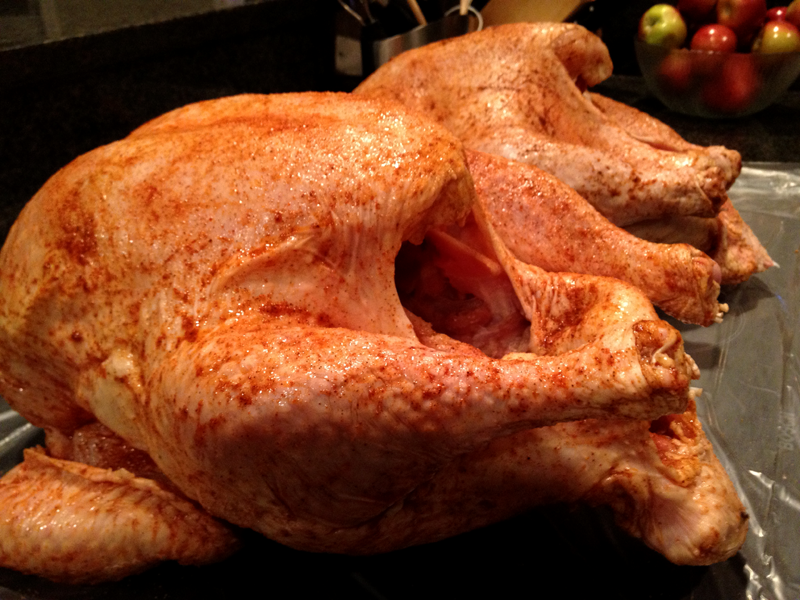
Make sure that the bird is completely defrosted. Remove the junk from the cavity of the bird and any plastic pop-up device–it won’t work here. Load the injector with your marinade. Carefully lift the skin from the meat and insert the needle into the meat rather than puncturing the skin. This keeps the marinade and natural juices from leaking from the turkey when you fry it. Do this in several locations, including the breast, thigh and drumstick (if your bird HAD a pop-up thermometer, you may as well use that hole also). As you retract the injector, press down on the plunger. Inject the breast in several different locations however be smart with each puncture hole and use each one in several different directions. The more marinade you use, the more flavorful the meat will be.
Try to do this the night before you plan on cooking the bird. This way it has several hours to marinade. The injection process definitely shortens the amount of time needed, so if you can’t do it the night before then a few hours before will have to do.
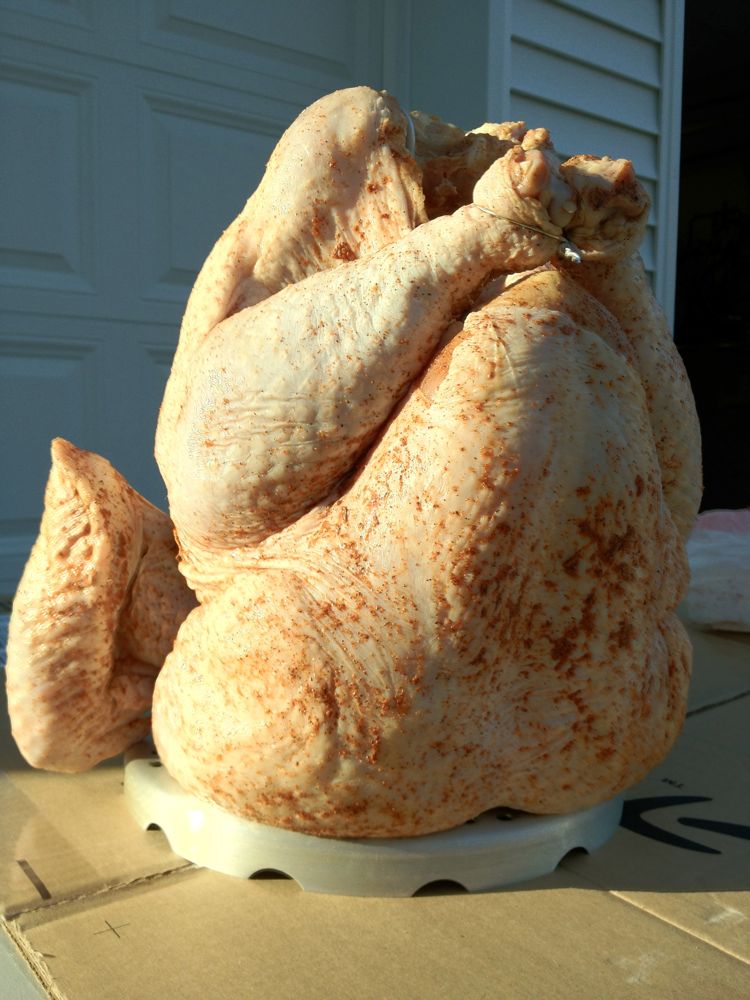
Using the dry seasoning, rub the bird all over… gently around the breasts and the thighs, then up and down the legs… yeah, you know you like it. Rubbing and massaging the bird will help the marinade to mingle with the meat.
BRING ON THE HEAT
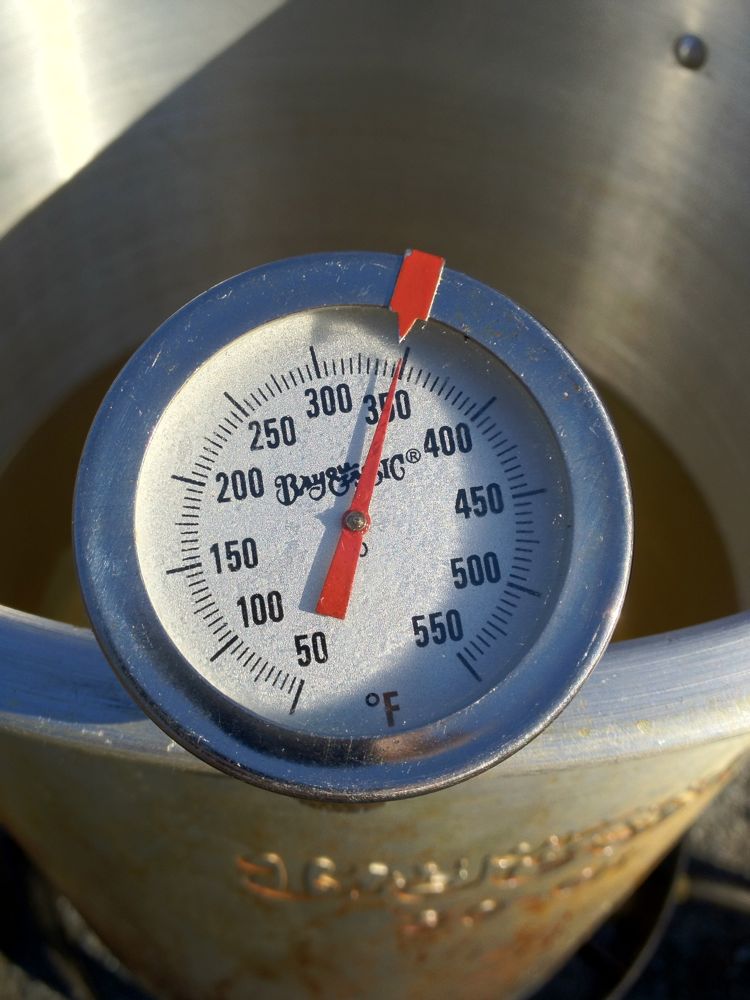
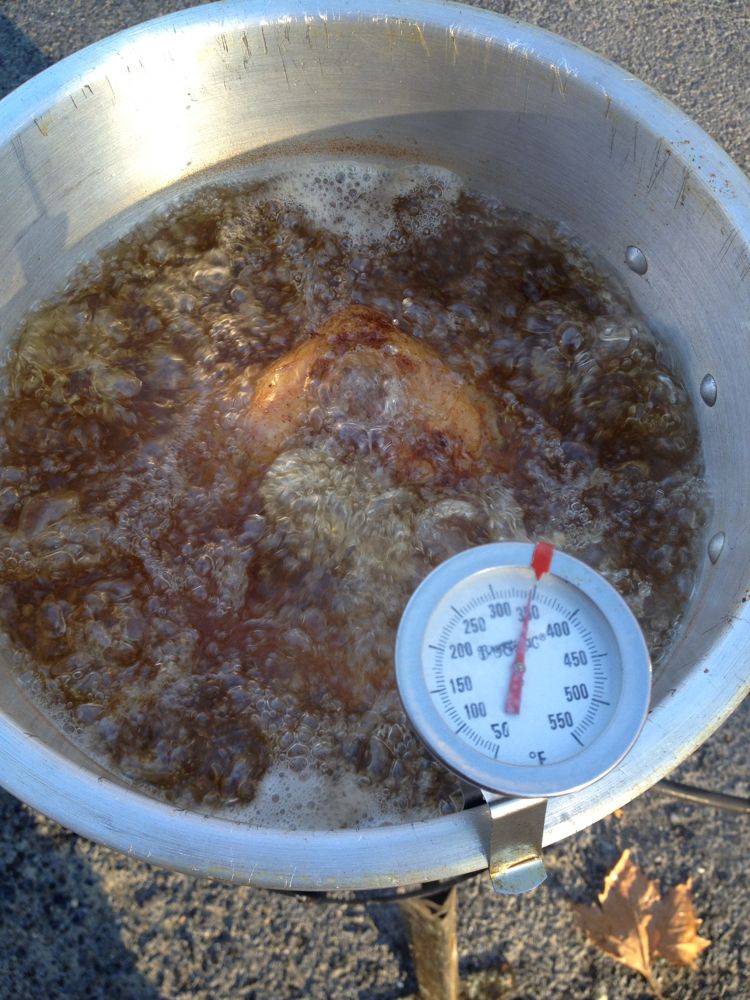
When you are ready to get cooking, put the oil into the pot and fire up the burner. It will take you at least 20-25 minutes to get the oil to 350° Fahrenheit depending on your burner, outdoor temp, and your elevation.
Make sure that the bird is dry. Water and oil do not mix very well–this would be pretty obvious if you threw an ice cube in the pot, but don’t do that. Instead, towel off the bird if you have to. Hold it up and make sure no water is in the chest cavity.
Place the bird on the turkey stand drumsticks up and head down (well, if he still had a head) and pull his arms back behind his shoulders if possible. I have recently began to hog-tie the leg stems together with wire to keep the legs from splaying open and laying on the side of the pot for the duration of the fry. This also keeps the legs close to the bird’s body and they will cook more evenly with said bird body.
When the oil has reached 350° (375° max), use the hook to lower the bird slowly into the oil–and I do mean slowly–this will keep the oil from boiling over. Seriously, I can’t stress this enough… do it SLOWLY. Wear oven mitts, heavy-duty construction or asbestos gloves, or welding gloves and a long sleeve shirt. Chef hat or “the South Will Rise Again” cap is optional.
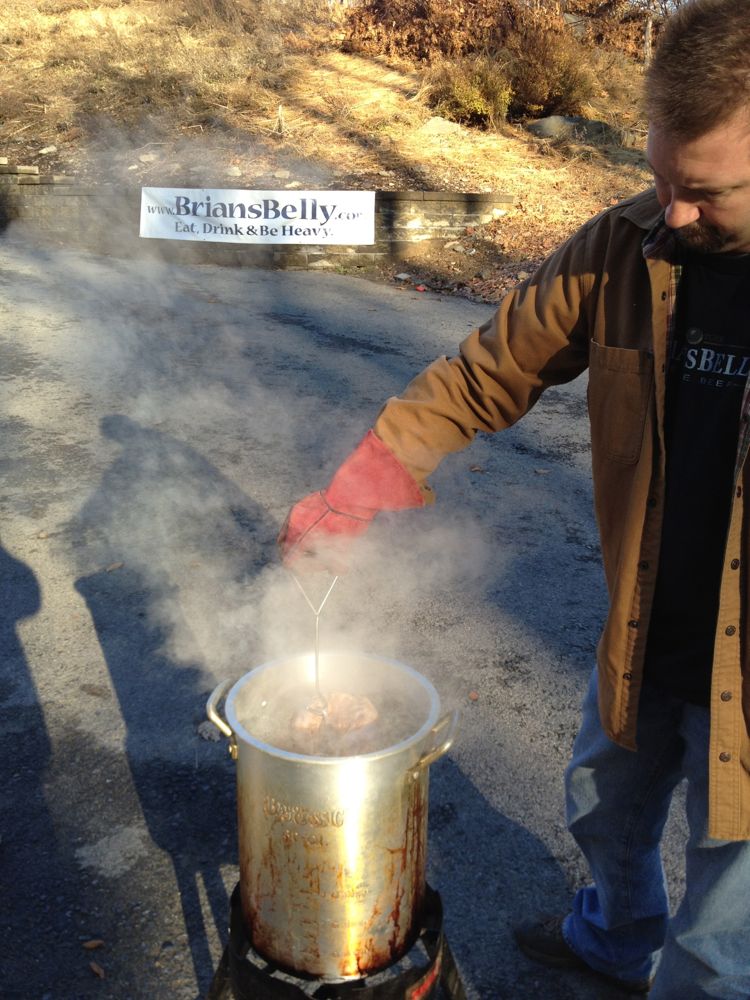 The oil temperature will drop because you are putting a cold–or preferably room temperature–bird into the pot. There are all kinds of scientific thermal transfer issues going on here that only Alton Brown could understand, but all we need to know is that something hot plus something cold equals something warm. Raise the burner a bit to get the temperature back up but don’t put the lid on in an attempt to speed this up- the oil will get way too hot. As mentioned earlier, a dangerous situation can occur when the oil gets too hot… 450ºF to be exact. That is the temperature at which peanut oil could flash or smoke. When it’s back at 350°, lower the burner. Also, try not to let the temperature drop well below 330º or your bird may start to soak up the oil.
Commenter BillC (below) has an excellent idea: “I’ve found that it’s wise to turn off the burner when lowering the turkey into the oil and when removing the turkey from the oil. This will remove the risk of igniting any oil that may spill over the top of the pot while you’re lowering or removing the turkey.” We think this is a great idea… a missing flame for a minute or so will probably do very little to the oil temp and will make the process a lot safer… Thanks Bill!
The cooking time varies and depends on the size of the bird. Since this is Brian’s Belly, we’ll put it in a table for you. This is assuming 350°. If for some reason you can’t get your flame hot enough, it’s time for a better burner, such as the Gas One 200,000 BTU burner. THIS IS JUST A GUIDE! YOU HAVE TO USE A MEAT THERMOMETER AND CHECK FOR 160°F!
| Temperature 350°F | ||
| Weight | Minutes Per Pound | Total Time |
| 10 pounds | 3 | 30:00 minutes |
| 11 pounds | 3 | 33:00 minutes |
| 12 pounds | 3 | 36:00 minutes |
| 13 pounds | 3 1/2 | 45:30 minutes |
| 14 pounds | 3 1/2 | 49:00 minutes |
| 15 pounds | 3 1/2 | 52:30 minutes |
| 16 pounds | 3 1/2 | 56:00 minutes |
| 17 pounds | 3 1/2 | 59:30 minutes |
| 18 pounds | 3 1/2 | 63:00 minutes |
| 19 pounds | 3 1/2 | 66:30 minutes |
| 20 pounds | 3 1/2 | 70:00 minutes |
As we then say in all of our Brian’s Belly recipes… now would be a good time to grab a beer.
 BREAK IS OVER
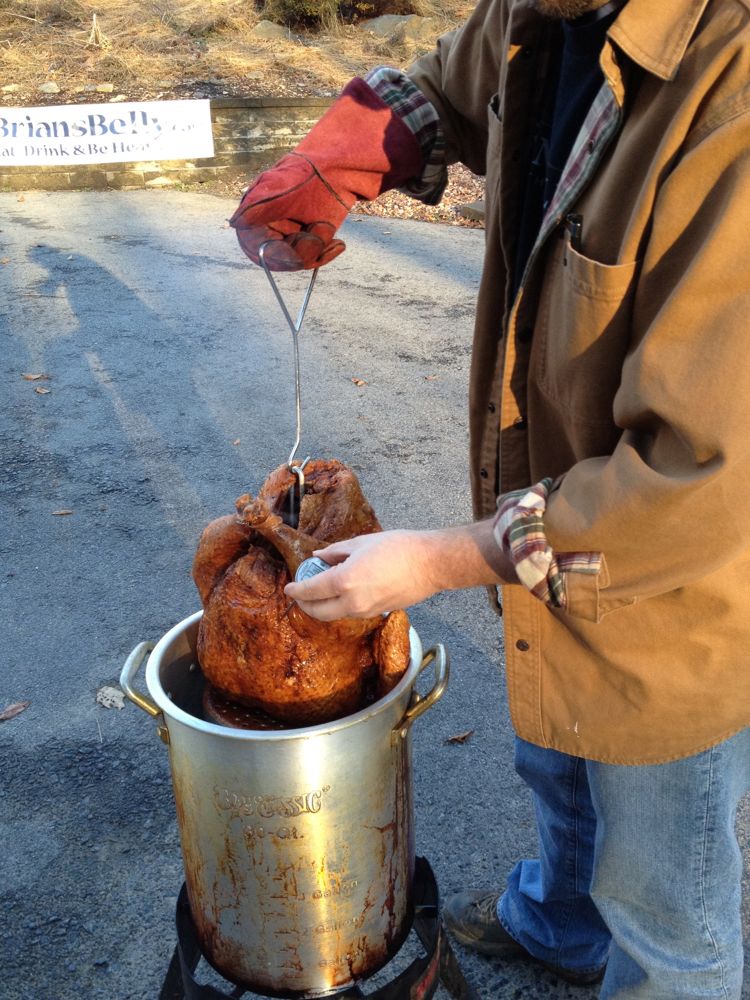
When time is up, don your mitts and using the hook, carefully lift the bird from the pot. Holding it over the oil, let it drip a while. Insert the meat thermometer into the breast. The temperature should be around 155-160° Fahrenheit. If it’s not, you may have to put it back it for a few more minutes- do not remove it too early or eat it undercooked.
Place it on a cutting board and cover it with aluminum foil for 20 minutes or so. The bird will continue to cook, even while sitting on your kitchen counter (this is called “carry-over” cooking) and will reach the optimal 170° that is recommended by the U.S. Dept. of Agriculture.
If you are done frying, turn the burner off! Consider removing the pot from the fry stand to a firm, level, heat-resilient surface out of harms way–three gallons of 350° oil can be deadly to dogs, small children and even careless (read: drunk) adults.
ACCEPT PRAISE
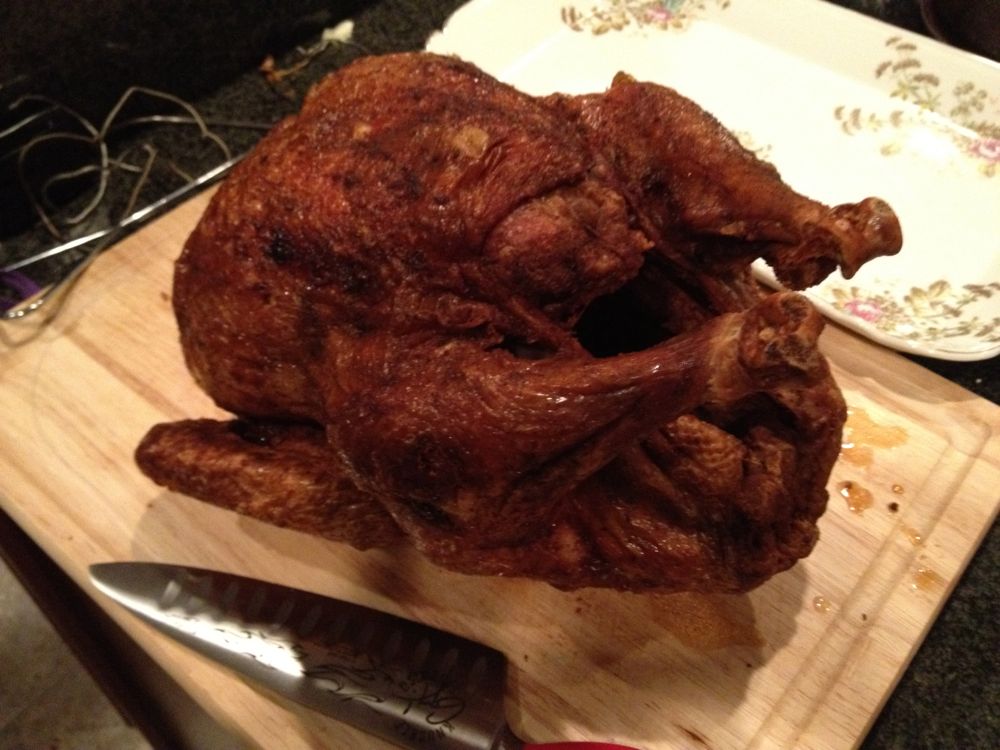 When you’re ready, carve it up (watch for squirting juices) and serve it up (watch for smiling faces).
When all is done, there is no reason to dump those three gallons (and about $25) worth of oil right back into the environment. Peanut oil is a high quality oil that can withstand several fry cycles. After the oil has cooled and the junk has settled (perhaps overnight) you can filter the oil and pump it back into the plastic container it came in. Stored in a cool, dry place, peanut oil should not spoil and will remain usable for six months. If you “smoked” the oil by accident, you’ll have to toss it. We feel obliged to tell you to check with your local regulations on proper disposal, but most of the time oil must be accepted at your neighborhood auto-mechanic shop.
I hope after you try your turkey this way, you will never go back to the oven. Got questions? Try posting in the comments below. Like this article? Let your friends know on Facebook or Twitter. Bird appétit!
Over the years, the popularity of this guide has prompted good discussion in the comments… you guys have added a lot of value to the conversation. Nestled among the questions and answers, there is a lot of great information. But the comments of any blog can be a big tl;dr… So with that in mind, I re-read and culled the best information and posted it here: 10 Turkey Tips for your Thanksgiving Deep Fry.
I’m always looking to supplement our deep fried Thanksgiving turkey with the proper Cajun accoutrement… whether it’s an appetizer or side dish. I’ve been toying around with a recipe for Fried Cajun Stuffing Balls and I decided to finally get it down in digital form.
Belly Buddy Scott Stout has a recipe for Hush Puppies that will also go great with your Deep Fried Turkey.
And Belly Buddy Fatty Matty has sent us the mix for a proper Turkey Rub for your bird if you don’t want to use a packaged seasoning.



Hello. I have found it safer to turn the burner off while lowering the bird into the hot oil. If you get a boil-over (or you drop it) you don’t have an ignition source. Then relight the burner once the bird has landed and check the oil temperature and maintain it around 350.
This is an excellent idea that we have promoted in the past. If you have done this before and/or are comfortable with the oil and the flame and have control over it, you can creep up to 375º F and shut the flame off. Then when your cold bird has brought the temp down, you can light back up and you are 25º ahead of the curve.
Can you do a wet brine prior to frying or do you recommend injecting only?
A brine adds a LOT of water/moisture to the bird. I recommend only brining if you will be roasting.
Best turkey frying site for sure. Been using for years. 3 tips I am adding. First, if you put ziplock bags with ice on the breasts for 30 min before cooking it slows down white meat from overcooking. Second, I get a 40 to 50 degree oil temp drop when the turkey first put in, so I push oil temp to about 380 to 390 right before I put turkey in–I am using very precise digital dot thermometer with long probe in oil from thermoworks so I am confident in temp guage. 3rd–if I keep oil temp at desired 350… Read more »
Thanks for the info Greg. I have always done the same with the oil as it’s a great idea. And funny you mention the cooking time table… this year I did two fifteen pounders one after the other and each one was done earlier than I anticipated. I think it’s because I usually do 17 lbs and was used to that timing. Anyway, thanks for the praise and keep on frying!
I have been using this site for over 15 years. The information is the best on the internet and the humor is great. Hands down or drumsticks up, this is the best fry site out there.
Thanksgiving 2019! Thanks for the help!
brune bonner pa dase
Deep Fried Turkey Recipe (Still the best guide on the net!) November 2018
I’ve been deep frying our turkey for at least 8 years following the instruction here, and we’ve always been very pleased with the results. This year, I used cottonseed oil instead of peanut oil for the first time, and the bird came out as black as a cannon ball.
I was there to watch the thermometer, and the temp stayed between 340 and 370 the whole time. The internal temp was spot on and the meat was juicy and delicious. The skin was good too, it just looked burnt. Is this common with cottonseed oil?
Okay Guys, I’ve been doing this about 15 years now and I have a great tip for cold weather deep frying. As you know, in cold and windy weather, it is tough keeping the temps up. Well, this years 20 degree (0 degrees with wind chill) thanksgiving forced me to get creative. So, I bought a used 55 gallon drum for $15 and had a hole drilled to run the propane hose through. The turkey fryer frame fit easily inside it and the height, with the pot, came to just below the lid of the drum – perfect! Not exaggerating,… Read more »
Wow! We had trouble here in the northeast as well… temp today was about 20° on average, but I managed with good management… full throttle after the birds went in and an eagle eye on my birds after! Happy thanksgiving all!
Hey everyone! I’ve been frying for a few years now and I usually keep the lid half on to block some of the splatter while cooking. What’s the consensus with using the lid while the turkey is frying? Is it better to not use it? Also, any benefit to using a basket as opposed to the hanger when placing the turkey in the fryer? Thanks in advance for the advice!
I always use a basket for everything – it’s just easier. As to the lid, I do use it to keep the temps consistent, if the weather is cold. Otherwise, on a warm day, I don’t bother.
Thanks for the reply!
Hi Brain !! Just letting u know I have created an app on my phone with your website and I have been referring back to it for at least the last 5 years!!! Thank you for covering everything you need to know. I’m grateftull for all the information and even tho I know what I’m doing. , I always refer back and double check. The best tip is to turn off burner when your Adding turkey to hot oil. God bless and happy thanksgiving !! I’m doing 2 tomoorw for my employees 😀
Thanks Aaron! Maybe one day we’ll have our own app, but excellent idea to just turn a bookmark of this site into a shortcut (that’s what I do)!
I always turn the burner off now when lowering the turkey… the 1 to 2 mins that it’s off makes very little difference to the temp and makes ALL the difference in the world for safety!
Hi Brian! I am preparing to fry my FIRST turkey this Christmas Day. I foolishly thought bigger is better, and purchased an 18lb bird. You mentioned cutting the wings and legs off before frying. Could I fry these after the bird, and if so, for how long? Thanks in advance!!
I am actually going to try a 19 pounder for the first time this year. My plan is to keep the oil level lower in the pot so the legs stick out a bit and do not overcook compared to the rest of the bird… will report back!
Greetings. I am embarrassed to ask my question, but this is where I come for turkey fryer advice. BriansBelly is THE BEST!
Now my question: has anyone done a turkey breast (only) in the fryer?
Advice?
Thank you as always.
Hi Dee Dee and thanks for the praise! Sorry I did not see this right away… I have never done just the breast, but I know that you can. Just inject it and season like for the entire bird and use a fry basket.
Used this recipe and directions for over 12 years…always a great success….thanks for sharing and have tuned many on to your page…..follow the rules and safely deep fry turkey without any incidents…..thanks
As always, invaluable! I have you bookmarked and come back every year!
Have a chicken broaster commercial one I plan on doing a 15lb turkey time wise. I’m not sure of but w ould be operating at apt 12lbs pressure . Any suggestions I could just use broaster as deep fryer
Next question: Okay, so we fry a turkey at Thanksgiving.
At Christmas, I like to fry a prime rib of beef and at Easter, I like to do a boneless leg of lamb.
I would love some advice on those from the belly buddies.
Wow, those sound like they will be delicious! I have never done anything like that so I would be hesitant to offer advice… though I will probably try it out now that my mouth is watering!
Thank you, Brian’s Belly, et.al. I come back here each year for a refresher. My daughter said that tonight’s bird was the best. ever. I did NOTHING to the turkey! (except fry it.) In the past I brined. Last year I injected a marinade that was so awful the bird was inedible. Tonight, I rinsed and dried the bird (no brine, no prep.). Rubbed it with a little bit of Montreal Chicken Rub, then dropped it (okay. lowered it. very very slowly.) into the 350° oil. Best turkey in years. Personal note re cookers: I have experience with only 2… Read more »
I think the injection/dry rub combo works best, but I have noticed that if I’m doing multiple birds that the dry rub almost becomes unnecessary by bird three because the oil is already so seasoned. The Montreal sounds like a nice variation. Thanks for your continued patronage!
David, does the cook time start once the bird is completely in the oil? or does it start once the oil temp gets back up to 350?
I would start the countdown from when you get the bird in the oil. If the temp drops too much and it takes a long time to get back up, then add a few minutes to the cook time. But remember, the table above is a guide… always go by the thermometer.
To emphasize, I always come back to the well developed article that got me hooked. I also love that you keep it updated. I post to Facebook every year!
Thank’s for returning and your continuing support! Have a great fry day!
Every year, just to ensure I have the right temps and cooking times. Thank you Brian’s Belly
IT’S ALMOST TURKEY TIME! But the forecast is calling for rain. I plan on deep frying no matter what. Any tips?
Just not indoors! Maybe an open car port or under a canpoy.
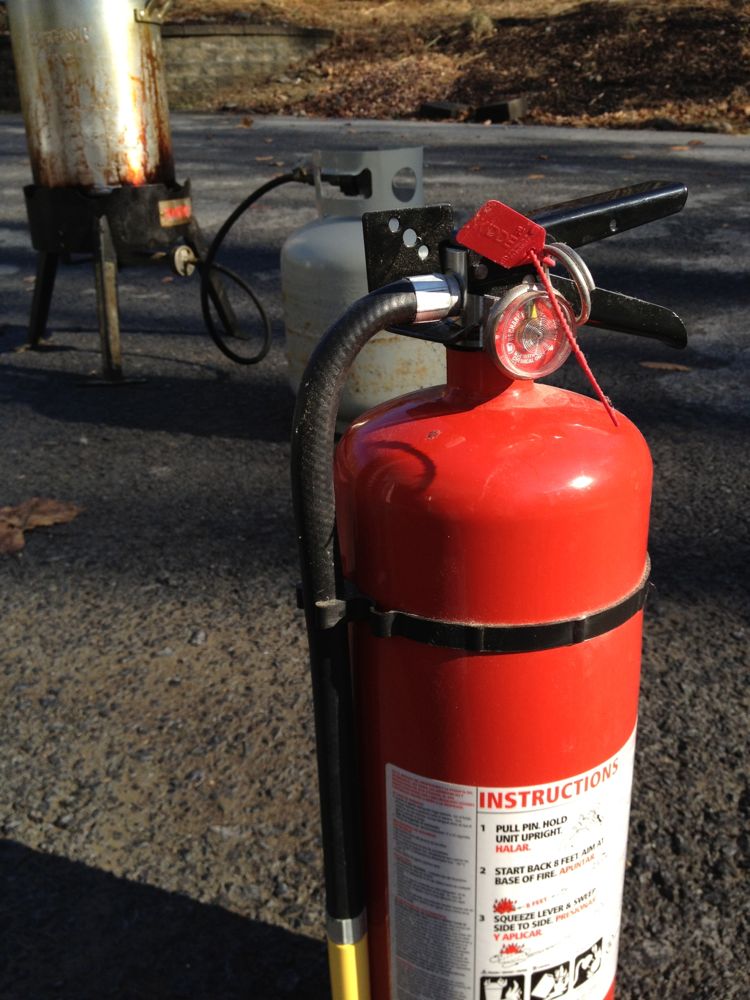
Thanks Robert. I have an eazy-up tent I plan on using. Keeping the extinguisher extra close though.
I plan on having a pop up tent ready to go later today just in case. I used one a few years ago during heavy snow and it worked great.
[…] and suggestions for choosing your Turkey size, and type of oil. In the market for a turkey fryer? Brian’s Belly has great reviews for fryers, as well as some general guidelines for deep frying your turkey. The […]
Can I re-use oil from this past Thanksgiving? It was brand new then and has been stored in my garage since?
New oil can last at least a year, depending on the expiration date. Used oil is six months. Both depend on how you store it. A cool, dark place is preferred.
I deep fried my first turkey yesterday. I used a 30 quart pot rubbed my 18 lb. plus turkey the night before, dried it out and put it in the fridge uncovered. Next day heated my 3.5 gallons of oil to 350 and slowly lowered turkey. Temperature never got over 250. Learned you can not use oil therm to check bird. Next time 12 lb bird and drop in at 400.
You also may want to consider a new burner or regulator. If you want to test them before t-day, fill your pot with 3 gallons of oil and check it with the fry thermometer. A burner may be blocked or not let in the proper amount of air; a bad regulator will limit the flow of propane. You still have some time to get new parts!
My fryer won’t get much over 275° since adding my my bird 25 min ago. Can I just cook it longer? Deeply disappointed.
Just hit 300°
I have fried turkeys for years and I always use peanut oil / 3 gal. I strain the oil using cheese cloth the next day and put it back in the same container and put it in the deep freeze. I usually save two gallons and toss the rest. The next year I have to only buy one gallon. The oil keeps just fine in the deep freeze.
Hmmm, not a bad idea, but the thing to remember is that if you do this for a few years in a row eventually you’ll have a blend of old oil and really old oil that you’re adding new oil to.
I have used your guide for 3 years , I have it on my phone as an app! Thanks for all the helpful tips, nothing better than frying ! I’m doing 2 at the same time for my employees.
[…] have found this tutorial to be super helpful, but honestly, there has been a lot of trial and error. It […]
How much rub do you use? I have the 8 oz bottle of tony chacheres creole. Thanks for the perfect guide…..been using it for years
It may be hard to see from the pics… I apply liberally the night before but a lot of it falls off during handing. So I typically sprinkle until the whole bird is covered knowing I’ll lose a lot of it… maybe an ounce if I had to guess?
Thanks for the praise… glad you keep coming back!
[…] kevin's mom: there is an up and a down vote button. where is the "you are probably being funny, but most likely a… From: Deep Fried Turkey (Still the best guide on the net!) […]
I come back to this page every year around this time to refresh my memory… glad to see your guide is ready for T-Day 2015! I have not picked up peanut oil yet this year, but it seemed surprisingly expensive at the grocery store last month.
Great site and instruction! I use this site every Thanksgiving!
This will be my third bird. Thanks!
I just found this site and actually as long as I have been frying turkeys, I didn’t really find much that I haven’t been doing already through lots of trial and error. You have a great site with so much valuable information for a novice. I’m no pro by any means, but I’ve fried well over 100 turkeys and I’ve got a few things that I have picked up on over the years. People sometimes complain about the temp dropping so low when they drop the bird. What I do is on the initial heating is to heat until the… Read more »
I love your guide and have been using it for the past 3 years. Have you ever pre-dipped your turkey in the peanut oil before heating it up (and you can even use this step to measure the exact amount of oil needed)? I’ve read that it will help with the transition of the bird into the hot oil (less splashing).
@Tim Thanks for continually coming back to this guide! I can’t see pre-dipping in oil being very much help with a transition… it may just make a drippy, oily mess. I haven’t dipped the bird in water to get a line in many many years either (but I think this comes with experience… I know that 3 to 3.5 gals of oil will not overflow in my pot with up to a 15lb turkey; also, oil expands… so you truly won’t get a good level that way). If I prep the bird the night before, let it sit in the… Read more »
Thank you so much for these great instructions. One question- do you apply the rub right after injecting and let it stay on tr turkey overnight also?
Thanks!!
@Tracir Yes, I put the rub on right after injecting it.
I’ve been frying turkeys for the last seven years. My family won’t have it any other way. Last year I made two turkeys (16 lbs each) and I STILL didn’t have many left overs! I love being outside, hovering around my fryer, eagerly anticipating the “Oooh Mom! That smells so good!” or the “Baby! You did it again!” that I hear from my family. I’m still amazed at how few people fry their turkeys. Your guide is super informative. I use Zatarains and Tony’s in many dishes and I can’t believe I’ve never tried it on my turkey! I usually… Read more »
Its always better to turn off gas burner at the time of lowering the turkey into the hot oil. This definitely removes the risk of igniting the oil while you’re lowering or removing the turkey.
[…] fires that erupted from this procedure because someone didn’t carefully read the instructions. Deep Fried Turkey Recipe. Great detailed walk […]
Brian’Belly
Thanks so much for all the good info. Followed the instructions to a T and everyone raved about the delicious bird I prepared. Cajun stuffing balls we also a hit.
Happy Thanksgiving!!
Question/recommendation? – I found that using a temperature probe inserted into the breast (that remains in the bird during the frying process) is the best method to gauge cooking time; however, I had to replace the probes and monitors and have not found one that I works reliably well outdoors (monitor in the freezing air temperature while the probe is in the bird and the cable partially submerged in the hot oil).
Any recommendations?
Thank you in advance for any insights –
In addition to trussing up the legs, it helps to tie up the wings too — after trussing the legs, tie the two wings together so the ends sit above the legs.
I tried frying a turkey this year and decided to go au-naturale (e.g. no seasonings, rubs, or injections) — my thought is that good meet doesn’t need dressing to be good meat. Wow, the flavor was amazing; I’m going to have to try a injecting sometime.
Thanks for the guide, Brian’s Belly!
If I could ‘Like’ your comment to Ben on 12-3-08, lol, def would. I appreciate ALL the info… AND, I know how to ‘scroll down’.
Went straight to your websight. Can’t imagine another one being ‘better’ or more informative. Great detailed info, thx. Now, going to check out your Fried Cajun !Stuffing balls. I did share on my fb page. Happy Turkey Day
I’ve been referencing this website for years! It’s still the best website around! Thanks to the site, I’ve mastered the deep fry turkey! Lets add more deep fry recipes!
This is a very good guide. Been frying turkeys on & off (whether or not I’m home and not stationed in some God-forsaken far away place) for 10 years. I always check a few web pages for reference, to confirm cooking times (poor memory here), and I gotta say, this info is the best I’ve found. Its really kinda hard to go wrong when deep frying a turkey if you follow the basics. Drying the bird prior to immersion is MOST important, to avoid possible overflow/fire issues. On last years bird, I only went with a dry rub just to… Read more »
This was a great article. I fry a turkey every year for thanksgiving and many other things throughout the year. I prefer to inject over brining. I’ve done both many times before but as you stated in the article if done properly the turkey is sealed once it hits the oil so you can make it as juicy as you like. Try half a good beer (no bud light) I like Sam Adams, 1/4 cup of apple juice or cider, a little cider vinegar, table spoon of honey or agave nector, then add what ever seasonings you like. Stir well,… Read more »
I have been deep frying turkeys and whole chickens for about 25 years now. And in my experience I have found out that putting a rub on the outside of your bird will only scorch your oil so I only inject. And I only use 100%peanut oil
you said you had a problem with your thermometer holder as did I. So I found a great solution for this. As being around Christmas my wife already set the tree up . I used a orniment hanger and a chlothes pin and wired it right to my shaft and bingo it was perfect and cheap.
Valerie, the turkey I plan to fry is a Butterball, which sounds like it might be self-basting?